Best Blue Collar Jobs in 2026: High Pay, No Degree Required
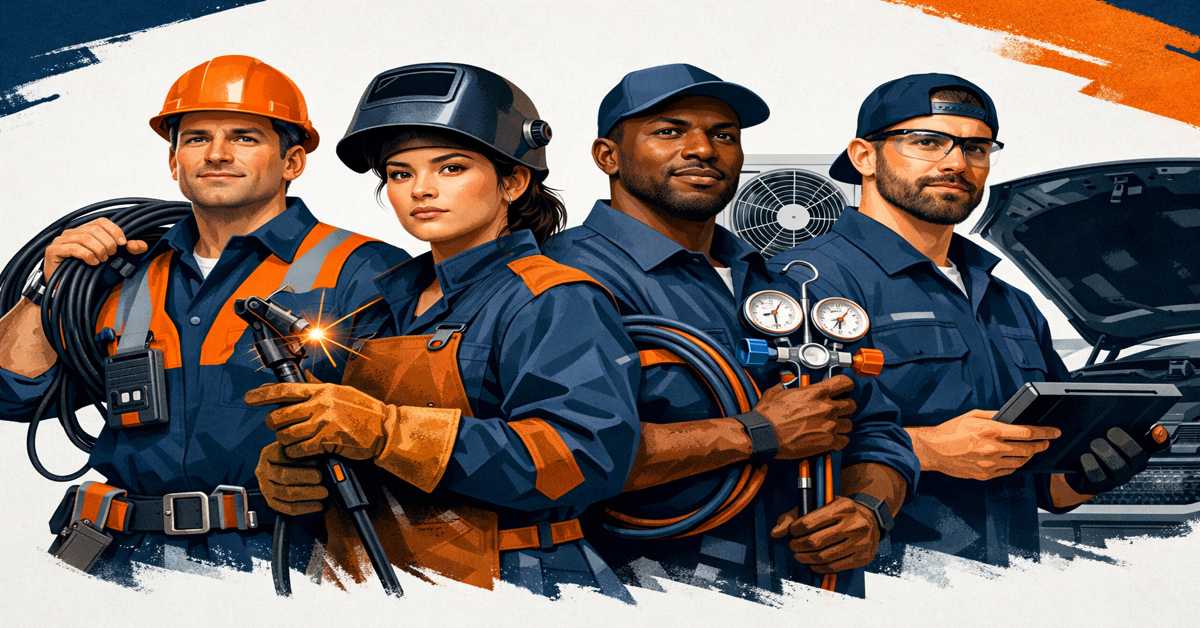
Blue collar jobs built America. They keep the lights on, the water running, the buildings standing, and the cars moving. And in 2026, they pay better than ever.
The skilled trades are facing a massive labor shortage. Millions of experienced workers are retiring. Not enough young people are entering the trades. The result? Companies are paying top dollar for skilled workers.
If you're looking for a career with high pay, job security, and no college degree required, blue collar jobs are your answer. This guide covers the best ones with real salary data.
Why Blue Collar Jobs Are Booming in 2026
Three things are driving blue collar wages up:
1. The labor shortage is getting worse. The average age of a skilled tradesperson is over 55. Retirements are accelerating. Trade schools can't graduate workers fast enough to fill the gap.
2. Infrastructure spending is at record levels. Billions in federal funding for roads, bridges, power grid upgrades, broadband, and clean energy are creating massive demand for skilled workers.
3. You can't outsource or automate these jobs. AI might replace desk jobs. It can't replace the plumber fixing your pipes, the electrician wiring your house, or the technician diagnosing your car. Blue collar work is AI-proof.
The result: blue collar workers have more bargaining power, higher wages, and better benefits than they've had in decades.
The 20 Best Blue Collar Jobs in 2026
Tier 1: $80,000 to $130,000+
1. Elevator Installer and Repairer
- Median salary: $106,580 (BLS)
- Top earners: $130,000+
- Install, maintain, and repair elevators and escalators
- Requires 4-year apprenticeship through IUEC
- One of the highest paying blue collar jobs in America
2. Electrical Lineman
- Median salary: $82,000
- Top earners: $120,000+ with overtime
- Install and repair high-voltage power lines
- One of the most dangerous trades - pay reflects the risk
- 3-4 year apprenticeship through IBEW
3. Construction Manager
- Median salary: $85,000
- Top earners: $130,000+
- Oversee construction projects from start to finish
- Most started as tradespeople and worked their way up
- Experience matters more than degrees
4. Industrial Electrician
- Median salary: $78,000
- Top earners: $110,000+
- Maintain electrical systems in factories and industrial facilities
- Requires apprenticeship and state licensing
Tier 2: $60,000 to $85,000
5. HVAC Technician
- Median salary: $59,810 (BLS)
- Experienced techs: $75,000 to $95,000+
- Install and repair heating and cooling systems
- Year-round demand in every climate
- For detailed salary data, see our HVAC technician salary guide
6. Plumber
- Median salary: $70,000
- Master plumbers: $100,000+
- Install and repair water, drainage, and gas systems
- Master plumbers who own their businesses earn the most
- 4-5 year apprenticeship plus licensing
7. Steamfitter / Pipefitter
- Median salary: $73,000
- Top earners: $105,000+
- Install piping systems for steam, chemicals, and high-pressure systems
- Specialized and well-compensated
8. Boilermaker
- Median salary: $85,000
- Top earners: $115,000+
- Build, install, and maintain large vessels and tanks
- Often requires travel - pay reflects it
9. Structural Ironworker
- Median salary: $70,000
- Top earners: $100,000+
- Erect steel frameworks for buildings and bridges
- Physically demanding and done at extreme heights
10. Millwright
- Median salary: $68,000
- Top earners: $95,000+
- Install and maintain heavy industrial machinery
- One of the most versatile trades
Tier 3: $45,000 to $70,000
11. Automotive Technician
- Median salary: $47,930 (BLS)
- Top dealership techs: $80,000 to $100,000+
- Diagnose and repair vehicles
- The gap between average and top techs is huge - diagnostic skills make the difference
- For detailed salary data, see our automotive technician salary guide
The automotive field is evolving fast. Modern vehicles run on complex computer systems. Technicians who invest in advanced diagnostic training earn significantly more. APEX Tech Nation offers AI-powered diagnostic training and a full 32-system Academy - helping techs build the skills that separate a $50,000 career from a $90,000 one.
12. Diesel Technician
- Median salary: $62,000
- Top earners: $85,000+
- Maintain and repair diesel engines in trucks, buses, and heavy equipment
- High demand driven by the trucking industry
13. Welder
- Median salary: $55,000
- Specialized welders: $90,000+ (pipeline, underwater, aerospace)
- Join metal parts using high heat
- Fast entry - welding certification in as little as 6 months
14. Sheet Metal Worker
- Median salary: $62,000
- Top earners: $85,000+
- Fabricate and install products made from thin metal sheets
- Many work in HVAC ductwork installation
15. Heavy Equipment Operator
- Median salary: $58,000
- Top earners (crane operators): $80,000+
- Operate bulldozers, excavators, cranes, and other large equipment
- Shorter training path than most trades
16. CDL Truck Driver
- Starting salary: $45,000 to $60,000
- Experienced OTR: $60,000 to $80,000
- Owner-operators: $100,000 to $200,000+ (before expenses)
- Fastest entry of any trade - CDL training in as little as 3 weeks
- Massive demand - the trucking industry needs hundreds of thousands of new drivers
17. Carpenter
- Median salary: $56,000
- Top earners: $80,000+
- Build and repair structures, frameworks, and finishes
- One of the most versatile construction trades
18. Machinist
- Median salary: $52,000
- CNC machinists: $60,000 to $80,000
- Operate precision machines to create metal parts
- CNC (computer numerical control) skills increase pay significantly
19. Painter (Industrial/Commercial)
- Median salary: $46,000
- Industrial painters: $55,000 to $70,000
- Commercial and industrial painting pays more than residential
- Bridge and structural painters earn premiums for height and hazard work
20. Landscaper / Grounds Manager
- Entry-level: $35,000 to $45,000
- Business owners: $60,000 to $100,000+
- Low barrier to entry
- Earnings scale dramatically with business ownership
Blue Collar vs White Collar: The Real Comparison
People love to compare blue collar and white collar careers. Here's the honest comparison nobody talks about:
The Money
Blue collar (trade school path):
- Training cost: $0 to $15,000
- Start earning: Age 18-20
- Starting salary: $35,000 to $55,000
- After 10 years: $65,000 to $100,000+
- Student debt: $0
White collar (college path):
- Training cost: $80,000 to $200,000+
- Start earning: Age 22-24
- Starting salary: $40,000 to $55,000
- After 10 years: $55,000 to $85,000 (varies wildly by major)
- Student debt: $30,000 to $100,000+
Net worth at age 30:
- A tradesperson who started at 18 has earned 12 years of income with zero debt
- A college graduate who started at 22 has earned 8 years of income minus student loan payments
The tradesperson is often $200,000 to $400,000 ahead in net worth by age 30. That gap is hard to close.
Job Security
Blue collar: Excellent. You can't outsource plumbing. You can't automate electrical work. AI isn't climbing into attics to fix AC units. As long as buildings exist, tradespeople have jobs.
White collar: Increasingly uncertain. AI is replacing analysts, writers, customer service reps, and even some programmers. Office jobs are being automated and offshored. The desk job your parents had might not exist in 10 years.
Physical Demands
Blue collar: Physically demanding. You're on your feet, lifting, climbing, and working in uncomfortable conditions. Your body takes wear over decades.
White collar: Sedentary. You sit at a desk. Different health problems - back pain, obesity, eye strain, mental health challenges from lack of physical activity.
Neither is easy. They're just difficult in different ways.
Satisfaction
Surveys consistently show that tradespeople report higher job satisfaction than the average office worker. Reasons include:
- Tangible results - you can see and touch what you built
- Independence - many tradespeople work autonomously
- Variety - every day and every job site is different
- Problem-solving - diagnosing and fixing real problems is deeply satisfying
- Respect - people genuinely appreciate someone who can fix their heat, unclog their drain, or get their car running
How to Get Started in Blue Collar Work
Option 1: Trade School / Vocational Training
The fastest path for most trades. Programs last 6 months to 2 years. You learn the fundamentals and graduate ready to work.
For help choosing the right program, read our vocational training institute guide.
Option 2: Apprenticeship
The traditional path. Earn money while learning from day one. Programs last 3 to 5 years. Graduate as a licensed journeyman with zero debt and years of experience.
Find apprenticeships at apprenticeship.gov or contact your local union hall.
Option 3: Entry-Level Position
Many trades let you start as a helper or laborer with no formal training. You learn on the job from experienced workers. This takes longer but requires no upfront investment.
Option 4: Military
All military branches train people in skilled trades - electrical, HVAC, diesel, construction, welding. The training is free, you earn a salary, and your skills transfer directly to civilian jobs.
Option 5: Self-Study and Online Training
For some trades - especially automotive technology - you can build foundational knowledge through self-study. APEX Tech Nation's Academy offers AI-powered training covering 32 vehicle systems, ASE certification prep, and real diagnostic scenarios. You can start learning before you ever set foot in a shop.
The Trades Your Parents Should Have Told You About
Here's the truth: for the last 30 years, high schools pushed every kid toward college. Guidance counselors, teachers, and parents all said the same thing - "go to college or you'll never make it."
That advice was wrong for millions of people.
The result:
- $1.7 trillion in student loan debt nationwide
- College graduates working jobs that don't require degrees
- A critical shortage of skilled workers
- Tradespeople earning more than many college graduates
The tide is turning. More people are recognizing that trade careers offer everything a college degree promises - good pay, job security, respect - without the crippling debt.
You don't need anyone's permission to choose a trade career. You just need the willingness to learn and work hard.
Frequently Asked Questions
What are the highest paying blue collar jobs? Elevator installers ($106,580 median), electrical linemen ($82,000+), construction managers ($85,000+), and industrial electricians ($78,000+) top the list. For a detailed breakdown, see our highest paying trade jobs guide.
Do blue collar jobs require a degree? No. Most blue collar careers require trade school (6 months to 2 years) or an apprenticeship (3-5 years). No four-year degree needed.
Are blue collar jobs safe? Safety has improved dramatically with modern equipment, training, and OSHA regulations. Some trades (linework, ironwork) carry more risk than others (HVAC, automotive). Following proper safety procedures is critical in every trade.
Can women work in the trades? Absolutely. Women are entering every trade in growing numbers. Programs actively recruit women. Success in the trades depends on skill and work ethic, not gender.
What blue collar jobs are in highest demand right now? Electricians, HVAC technicians, plumbers, welders, and CDL drivers are all facing severe shortages. These fields have the most job openings relative to available workers.
Is it too late to start a trade career at 30 or 40? No. Many people switch to trades later in life. Employers value maturity and work ethic. There's no age limit on building a great career.
What trade should I choose? Consider what type of work you enjoy. Like working with vehicles? Check out automotive technician careers. Like working with electricity? Read our electrician apprenticeship guide. Like the idea of fast entry? Look at welding or CDL training.
How do I know if a trade career is right for me? Ask yourself: Do I like working with my hands? Am I good at solving problems? Do I prefer being active over sitting at a desk? Would I rather earn money now than spend 4 years in college? If you answered yes to most of these, a trade career is worth exploring.
What to Do Right Now
- Pick a trade that interests you. Use the salary data above and our highest paying trade jobs guide to compare your options.
- Search for training programs at your local community college or on apprenticeship.gov. Read our vocational training institute guide for help choosing the right school.
- Complete your FAFSA at fafsa.gov if you're considering trade school. You may qualify for grants that cover your entire tuition.
- Talk to people in the trade. Visit a job site, stop by a union hall, or reach out to working tradespeople. First-hand insight is invaluable.
- If you're interested in automotive careers, start building your skills now with APEX Tech Nation. AI-powered diagnostics, ASE prep, and a full 32-system Academy. Built by a tech. For techs.
Blue collar jobs aren't a backup plan. They're a career path that offers high pay, real job security, and the pride of building something that matters. The world needs more skilled tradespeople. The question isn't whether the opportunity is there - it's whether you're ready to grab it.
Join the Nation - APEX Tech Nation. Built by a Tech. For Techs. 🔧
Interested in Automotive?
APEX Tech Nation is the go-to platform for automotive technicians. Free AI diagnostics, training, ASE prep, and a community of working techs. Built by Anthony Calhoun.
Visit APEX Tech Nation