How to Get an Electrician Apprenticeship in 2026: Step-by-Step Guide
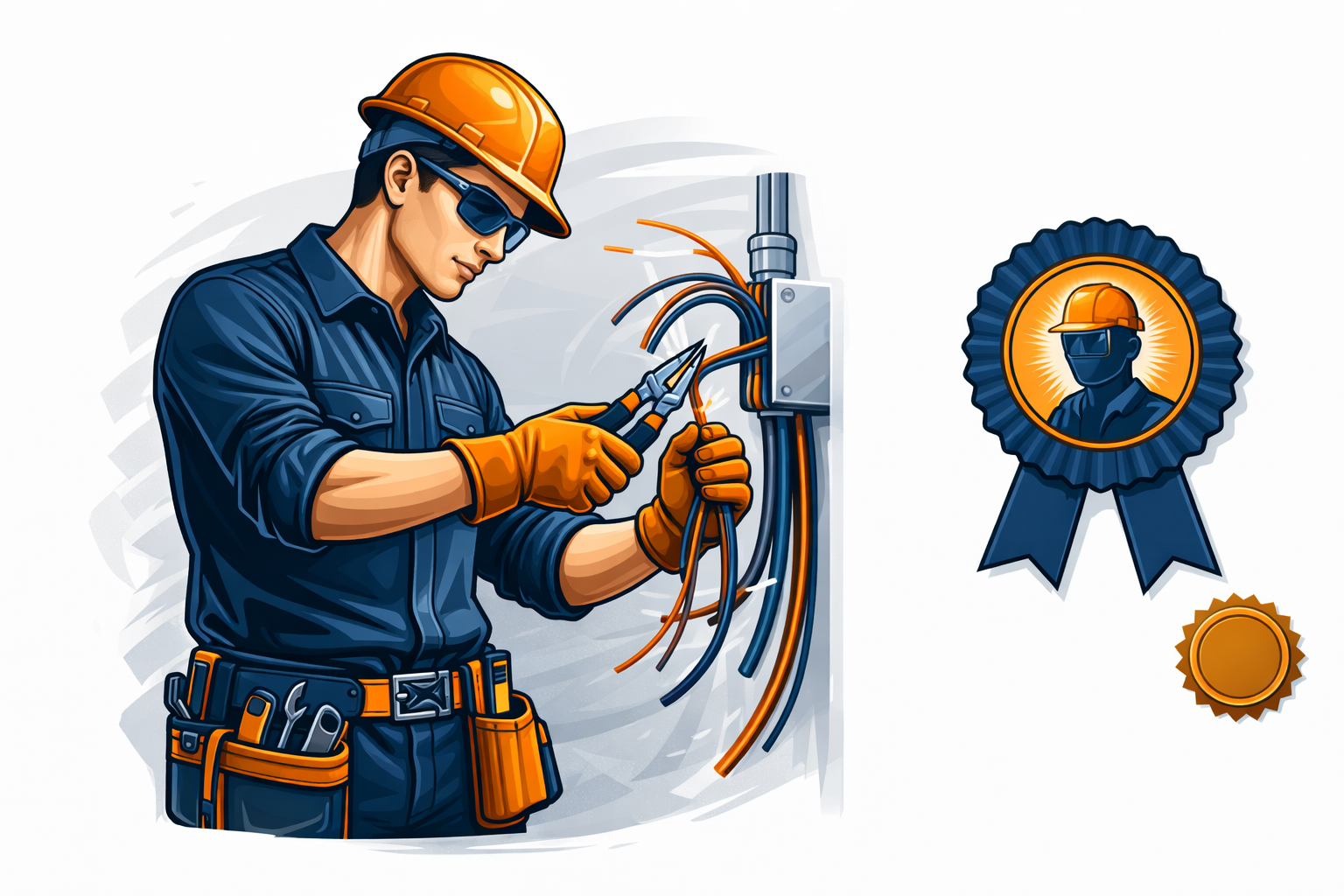
Electrician is one of the best trade careers you can choose. The pay is strong. The demand is growing. And you don't need a college degree to start.
The best way to become an electrician? An apprenticeship. You earn money from day one while learning from experienced electricians. No student debt. No classroom-only theory. Real work, real skills, real pay.
This guide walks you through exactly how to get an electrician apprenticeship in 2026.
What Is an Electrician Apprenticeship?
An electrician apprenticeship is a paid training program that combines on-the-job work with classroom instruction. You work alongside licensed electricians during the day and attend classes at night or on weekends.
Here's what makes it great:
- You get paid from day one - no tuition, no debt
- Training lasts 4 to 5 years
- You learn by doing real electrical work on real job sites
- You graduate as a licensed journeyman electrician
- Your pay increases every year as your skills grow
By the time you finish, you'll have 4-5 years of work experience, a journeyman license, and zero student debt. A college graduate starting at the same age has 4 years of debt and zero work experience.
How Much Do Electrician Apprentices Get Paid?
Apprentice pay starts lower than journeyman pay but increases every 6 to 12 months as you advance through the program.
Typical apprentice pay progression:
- Year 1: $16 to $22 per hour (40-50% of journeyman rate)
- Year 2: $19 to $26 per hour (50-60% of journeyman rate)
- Year 3: $22 to $30 per hour (60-70% of journeyman rate)
- Year 4: $25 to $34 per hour (70-80% of journeyman rate)
- Year 5: $28 to $38 per hour (80-90% of journeyman rate)
After completing your apprenticeship and earning your journeyman license, you earn the full journeyman rate. The national median for electricians is approximately $61,500 per year ($29.56/hour) according to the Bureau of Labor Statistics. Experienced electricians earn $75,000 to $100,000+.
Over the course of a 5-year apprenticeship, you'll earn approximately $150,000 to $250,000 in total wages. Compare that to spending $80,000 to $200,000 on a college degree.
Types of Electrician Apprenticeships
Union Apprenticeship (IBEW/NJATC)
The International Brotherhood of Electrical Workers (IBEW) runs apprenticeship programs through local Joint Apprenticeship and Training Committees (JATC) across the country.
Pros:
- Highest quality training in the industry
- Best pay and benefits during training
- Health insurance and pension from day one
- Structured curriculum - 8,000+ hours on the job plus 900+ hours of classroom
- Strong job placement after graduation
- No tuition cost
Cons:
- Very competitive to get in (some locals accept only 10-20% of applicants)
- Application windows are limited (usually once or twice per year)
- Must follow union rules and work assignments
- Some locations have waiting lists
How to apply: Contact your local IBEW union hall or visit njatc.org to find programs near you. Each local has its own application process and timeline.
Non-Union Apprenticeship (IEC / ABC)
The Independent Electrical Contractors (IEC) and Associated Builders and Contractors (ABC) offer non-union apprenticeship programs.
Pros:
- Easier to get accepted (less competitive)
- More flexibility in choosing employers
- Available in more locations
- Some programs allow you to start any time (not just during specific windows)
Cons:
- Pay may be lower than union programs
- Benefits vary by employer (not guaranteed)
- Training quality varies more between programs
- May have small tuition costs ($500 to $2,000 per year)
How to apply: Visit iecnational.org or abc.org to find programs near you.
Employer-Sponsored Apprenticeship
Some electrical contractors run their own registered apprenticeship programs. You work for the company and they provide training that meets state and federal requirements.
How to find these: Search apprenticeship.gov for registered electrical apprenticeship programs in your state. Or contact local electrical contractors directly and ask if they offer apprenticeships.
Requirements to Apply
Requirements vary by program, but most electrician apprenticeships require:
Basic requirements:
- Age: At least 18 years old
- Education: High school diploma or GED
- Math: Algebra is required. You'll use math every day as an electrician. Some programs require you to have completed at least one year of high school algebra.
- Physical ability: Must be able to lift 50+ pounds, climb ladders, work in tight spaces, and stand for long periods
- Driver's license: Most programs require a valid driver's license
- Drug test: Most programs require passing a drug screening
- Legal right to work in the United States
Additional requirements for IBEW/JATC programs:
- Pass an aptitude test (math and reading comprehension)
- Complete an interview with the selection committee
- Some locals require pre-apprenticeship courses or previous electrical experience
You do NOT need:
- A college degree
- Previous electrical experience (though it helps)
- Your own tools (provided by employer in most cases)
- Special connections or family in the trade
How to Apply: Step by Step
Step 1: Decide Union or Non-Union
Research both options in your area. Visit the local IBEW hall and talk to members. Contact IEC or ABC programs too. Compare the pay, benefits, training quality, and acceptance rates.
If you want the best training and highest pay: IBEW union apprenticeship
If you want easier entry and more flexibility: IEC or ABC non-union program
Step 2: Find Programs Near You
- Union (IBEW): Visit njatc.org or call your local IBEW hall
- Non-union (IEC): Visit iecnational.org
- Non-union (ABC): Visit abc.org
- All registered programs: Search apprenticeship.gov
- State programs: Contact your state's Department of Labor
Step 3: Check the Application Window
Union programs typically accept applications once or twice per year during a specific window. Non-union programs may accept applications year-round.
Don't miss the window. Mark the dates on your calendar. Check the program's website or call them to find out when applications open.
Step 4: Prepare for the Aptitude Test
IBEW programs require an aptitude test that covers:
- Math: Algebra, fractions, decimals, basic geometry
- Reading comprehension: Understanding technical passages
How to prepare:
- Review basic algebra - this is the biggest section
- Practice fractions and decimals until they're easy
- Take practice aptitude tests online (search "IBEW aptitude test practice")
- Consider a math refresher course at a community college if needed
- Study for at least 2-4 weeks before the test
The aptitude test is the biggest hurdle. Many applicants fail because they didn't prepare for the math. Don't let that be you.
Step 5: Ace the Interview
If you pass the aptitude test, you'll be invited to interview with the selection committee. They're looking for:
- Motivation: Why do you want to be an electrician?
- Reliability: Will you show up every day on time?
- Work ethic: Are you willing to work hard and learn?
- Communication: Can you follow instructions and work with a team?
- Long-term commitment: Will you complete the full apprenticeship?
Tips for the interview:
- Dress professionally (business casual minimum)
- Arrive early
- Make eye contact and give firm handshakes
- Have specific reasons why you want to be an electrician
- Mention any relevant experience (even home electrical projects)
- Be honest about what you don't know - they expect apprentices to learn on the job
- Show enthusiasm and willingness to work hard
Step 6: Complete Pre-Apprenticeship Training (If Required)
Some programs require or recommend pre-apprenticeship courses. These short programs (2 to 12 weeks) teach:
- Basic electrical theory
- Safety practices (OSHA 10)
- Basic hand tool use
- Construction math
- Blueprint reading basics
Pre-apprenticeship programs improve your chances of being accepted and help you succeed once you start.
Step 7: Start Working and Learning
Once accepted, your apprenticeship begins. You'll alternate between:
- On-the-job training: Working on real job sites under a journeyman electrician
- Classroom instruction: Electrical theory, NEC code, safety, blueprint reading
Show up every day. Work hard. Ask questions. Be the apprentice every journeyman wants on their team. Your reputation starts building on day one.
What You'll Learn During Your Apprenticeship
Over 4-5 years, you'll learn:
Year 1-2 (Foundation):
- Electrical safety and OSHA requirements
- Basic wiring methods
- Residential electrical systems
- How to read blueprints and schematics
- Using hand and power tools
- National Electrical Code (NEC) basics
- Conduit bending
- Basic troubleshooting
Year 3-4 (Intermediate):
- Commercial electrical systems
- Motor controls and starters
- Transformers
- Grounding and bonding
- Advanced NEC code
- Fire alarm systems
- Low voltage systems
- Advanced troubleshooting
Year 5 (Advanced):
- Industrial electrical systems
- Programmable logic controllers (PLCs)
- Variable frequency drives (VFDs)
- Complex control systems
- Project leadership
- Journeyman exam preparation
After Your Apprenticeship
Journeyman Electrician
After completing your apprenticeship, you take the journeyman electrician exam. Pass it and you're a licensed journeyman electrician. You can work independently and earn full journeyman wages.
Journeyman electrician salary: $61,500 to $85,000+ per year. Top earners in high-demand areas or specialties make $90,000 to $110,000+.
Master Electrician
After 2-4 years as a journeyman (varies by state), you can take the master electrician exam. A master electrician can:
- Pull electrical permits
- Run their own electrical business
- Supervise journeymen and apprentices
- Design electrical systems
Master electrician salary: $75,000 to $120,000+ per year. Master electricians who own their own businesses often earn $100,000 to $200,000+.
Electrical Specializations
After earning your journeyman license, you can specialize in high-demand areas:
- Industrial controls / PLC programming: $80,000 to $110,000
- Solar / renewable energy: $65,000 to $90,000
- Fire alarm systems: $60,000 to $85,000
- Data / telecom wiring: $55,000 to $80,000
- High voltage linework: $80,000 to $120,000+
For a complete list of trade salaries, check out our highest paying trade jobs guide.
Electrician vs Other Trades
How does an electrical career compare to other trades?
Electrician vs HVAC Technician:
- Similar pay range
- Electrical has a longer apprenticeship (5 years vs 2-4 years for HVAC)
- Electrical has more licensing requirements
- Both have excellent job security
Electrician vs Plumber:
- Very similar pay and career path
- Both require 4-5 year apprenticeships
- Both require licensing
- Plumbing is more physical, electrical is more technical
Electrician vs Welder:
- Welding has faster entry (6-12 months vs 4-5 years)
- Electricians generally earn more long-term
- Welding is more physically demanding
- Electricians have more career advancement options
Automotive Electrical: A Growing Specialty
With electric vehicles (EVs) and advanced automotive electronics growing rapidly, there's a crossover between electrical work and automotive technology. If you're interested in the automotive side of electrical work, diagnostic skills are becoming essential.
Modern vehicles run on complex computer systems and high-voltage batteries. Technicians who understand both electrical theory and automotive diagnostics are in extremely high demand. Automotive Technical Institutes like Apex Tech Nation help automotive technicians build diagnostic skills through AI-powered training - bridging the gap between traditional electrical knowledge and modern vehicle technology.
Frequently Asked Questions
How long does an electrician apprenticeship take? Most programs are 4 to 5 years. This includes 8,000+ hours of on-the-job training and 900+ hours of classroom instruction.
Do I need experience to apply? No. Apprenticeships are designed for people with no electrical experience. That's the whole point - you learn on the job. However, any construction or hands-on experience helps your application.
How competitive is it to get into an IBEW apprenticeship? Very competitive. Some locals accept only 10-20% of applicants. The aptitude test and interview are the main filters. Prepare thoroughly for both.
Can I become an electrician without an apprenticeship? In some states, yes. Some states allow you to gain experience working under a licensed electrician without a formal apprenticeship. But the apprenticeship path is the most structured and often leads to higher pay.
What's the difference between an electrician and a lineman? Electricians work on building wiring systems. Linemen work on outdoor power lines and utility infrastructure. Linemen typically earn more but the work is more dangerous and involves more travel.
Is electrical work dangerous? It can be if safety practices aren't followed. Electrical shock, arc flash, and falls are the main risks. Apprenticeship programs teach extensive safety practices. Following proper procedures makes the work safe.
Can women become electricians? Absolutely. Women make up a growing percentage of electrical apprentices. Programs actively recruit women. The work requires technical skill and problem-solving - not just physical strength.
What tools do I need to start? Most employers provide tools for apprentices. As you advance, you'll build your own tool collection. Basic tools include wire strippers, pliers, screwdrivers, a multimeter, and a voltage tester. Expect to invest $500 to $1,500 in personal tools over the course of your apprenticeship.
What to Do Right Now
- Find your local IBEW hall at njatc.org or by searching "IBEW local [your city]." Call them and ask when the next application window opens.
- Search apprenticeship.gov for all registered electrical apprenticeships in your area - union and non-union.
- Start studying algebra if your math is rusty. The aptitude test is the biggest hurdle. Free resources are available on Khan Academy.
- Get OSHA 10 certified online. It takes about 10 hours and costs $25 to $35. Having this before you apply shows initiative and safety awareness.
- Talk to working electricians. Ask them about their experience, what they wish they knew starting out, and whether they recommend their local program.
- Compare careers using our highest paying trade jobs guide and HVAC salary guide to make sure electrical is the right fit for you.
An electrician apprenticeship is one of the smartest career moves you can make. You earn while you learn. You graduate with zero debt. And you enter a career that pays $60,000 to $100,000+ with rock-solid job security. The lights always need to stay on.
Interested in Automotive?
APEX Tech Nation is the go-to platform for automotive technicians. Free AI diagnostics, training, ASE prep, and a community of working techs. Built by Anthony Calhoun.
Visit APEX Tech Nation