Machinist Salary in 2026: How Much Do Machinists Make?
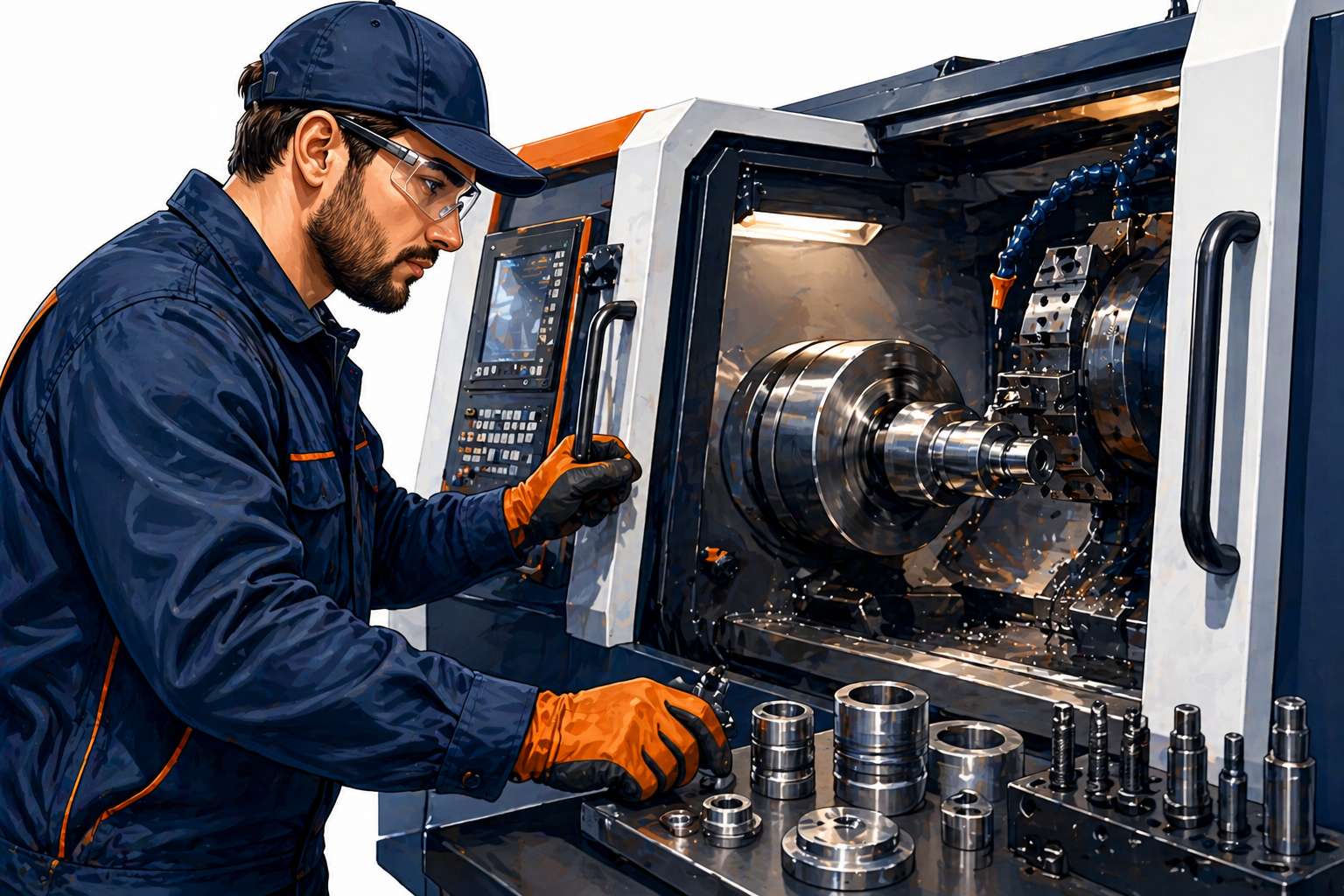
Every manufactured product you touch started as raw material that a machinist turned into a precision part. The engine in your car. The implant in your knee. The turbine in a jet engine. The parts inside your phone.
Machinists make the parts that make everything else work. And with American manufacturing surging back, the demand for skilled machinists has never been stronger.
This guide breaks down real machinist salary data for 2026 - from entry-level manual machinists to high-earning CNC programmers and tool and die makers.
Machinist Salary Overview
Here are the verified numbers for 2026:
- Entry-level (0-2 years): $34,000 to $42,000 per year
- Mid-level (3-5 years): $44,000 to $56,000 per year
- Experienced (5-10 years): $55,000 to $68,000 per year
- Senior / CNC Programmer (10+ years): $65,000 to $85,000+ per year
National median: approximately $47,940 per year or about $23.05 per hour according to the Bureau of Labor Statistics.
But that median hides a wide range. Entry-level manual machinists on the low end pull the number down. CNC machinists, CNC programmers, and tool and die makers on the high end earn $60,000 to $90,000+. The top 10% of machinists earn over $66,000 and specialized machinists in aerospace, medical, and defense earn well above that.
The key factor is CNC. Machinists who can program and operate Computer Numerical Control machines earn significantly more than manual machinists. The industry is moving almost entirely to CNC. If you learn CNC, your earning potential jumps dramatically.
Manual Machinist vs CNC Machinist
This distinction drives everything about your career and your pay.
Manual Machinist
Pay: $38,000 to $55,000 per year
Manual machinists operate traditional machines - lathes, milling machines, grinders, drill presses - using hand controls. You read blueprints, set up the machine, and control the cutting process by hand.
Manual machining is becoming rare. Most production has moved to CNC. Manual skills are still valued for prototype work, repairs, one-off parts, and toolroom work. But if manual machining is your only skill, your career options are shrinking.
The upside: Manual machinists who are truly skilled at their craft are hard to find. Shops that need prototype work, custom parts, or toolroom support pay premium rates for experienced manual machinists.
CNC Machinist
Pay: $45,000 to $72,000 per year
CNC machinists operate computer-controlled machines. You load programs, set up tooling, run parts, and monitor the process. CNC machines can produce parts faster, more accurately, and more consistently than manual machines.
CNC is the present and future of machining. Every manufacturing shop is moving to CNC. Learning CNC operation is the minimum requirement for a modern machining career.
CNC Programmer
Pay: $58,000 to $85,000+ per year
CNC programmers write the programs that tell CNC machines how to cut parts. Using CAD/CAM software (like Mastercam, Fusion 360, or SolidWorks CAM), you design the cutting paths, select tools, set speeds and feeds, and optimize the process for efficiency and quality.
This is the highest-paying machinist role that doesn't involve management. CNC programmers combine machining knowledge with computer skills. The better you are at programming, the more valuable you become.
CNC programmers who also set up and run the machines - doing the entire process from program to finished part - are the most valuable machinists in any shop.
Tool and Die Maker
Pay: $55,000 to $78,000+ per year
Tool and die makers are the elite of the machining world. They build the molds, dies, jigs, fixtures, and special tools that other machines use to produce parts. The work requires the highest level of precision and skill.
BLS median for tool and die makers: $57,000 per year. Experienced tool and die makers in aerospace or automotive earn $70,000 to $85,000+.
This specialty is shrinking in numbers but the remaining tool and die makers are highly valued. If you develop this skill, you'll never struggle to find well-paying work.
Salary by Industry
Where you work matters as much as what you do. Different industries pay machinists very differently.
Aerospace Manufacturing
$55,000 to $85,000+ per year
Making parts for aircraft, jet engines, satellites, and defense systems. Aerospace machining requires extreme precision - tolerances measured in thousandths of an inch. The materials are exotic (titanium, Inconel, aircraft-grade aluminum) and the quality standards are the highest in any industry.
Aerospace pays the most because the consequences of a bad part are catastrophic. A machined part in a jet engine can't fail. That responsibility commands premium pay.
Medical Device Manufacturing
$50,000 to $78,000 per year
Making implants, surgical instruments, and medical device components. Like aerospace, medical machining requires extreme precision and strict quality control. Materials include titanium, stainless steel, and specialty alloys.
Growing rapidly as the population ages and demand for medical devices increases.
Automotive Manufacturing
$45,000 to $65,000 per year
Making engine components, transmission parts, suspension pieces, and other automotive components. High volume, fast pace, and tight tolerances. The pay is solid but typically lower than aerospace or medical because the volumes are higher and the materials are less exotic.
Defense / Military
$52,000 to $78,000 per year
Making weapons components, vehicle parts, and military equipment. Often requires security clearance, which limits the applicant pool and increases pay. Government contracts provide stable, long-term work.
Oil and Gas
$55,000 to $80,000 per year
Making valves, fittings, drill components, and pipeline parts. The work is specialized and often requires machining large, heavy parts from tough materials. Pay fluctuates with oil prices but is generally above average.
General Job Shop
$40,000 to $60,000 per year
Working in a shop that takes on a variety of projects from different customers. You'll see every kind of part and material. The variety is great for learning but the pay is usually lower than specialized industries.
Prototype / R&D Shop
$48,000 to $70,000 per year
Making one-off prototype parts for engineers and product developers. This is where manual machining skills are most valued. The work is interesting - every part is different - and the pay reflects the high skill level required.
Salary by State
Highest paying states for machinists:
- Connecticut: $62,000 to $78,000 (aerospace hub - Pratt & Whitney, GE Aviation)
- Washington: $60,000 to $76,000 (Boeing)
- Massachusetts: $58,000 to $74,000
- California: $55,000 to $72,000
- Minnesota: $54,000 to $68,000 (medical device hub - Medtronic)
- New Jersey: $54,000 to $68,000
- Illinois: $52,000 to $66,000
States with solid but lower pay:
- Ohio: $44,000 to $58,000 (heavy manufacturing base)
- Michigan: $44,000 to $58,000 (automotive manufacturing)
- Texas: $44,000 to $58,000
- Indiana: $42,000 to $56,000
- Pennsylvania: $44,000 to $58,000
- Wisconsin: $44,000 to $58,000
Manufacturing hubs matter. States with major aerospace (Connecticut, Washington), medical device (Minnesota, Massachusetts), or automotive (Michigan, Ohio) industries have the most machinist jobs and often the highest pay.
Overtime in Machining
Manufacturing runs on deadlines. When orders are heavy, overtime is available - and sometimes mandatory.
At $23/hour base, overtime pays $34.50/hour. Working 50 hours per week instead of 40 adds $17,940 per year.
Common overtime situations:
- Rush orders with tight deadlines
- Production backlogs during busy periods
- Prototype work for product launches
- Defense contracts with government deadlines
- Second and third shift premiums ($1 to $3/hour extra)
Shift differentials are common in machining. Evening shift typically adds $1 to $2/hour. Night shift adds $2 to $3/hour. If you're willing to work second or third shift, you earn more per hour for the same work.
Many machinists earn $5,000 to $15,000 per year in overtime and shift premiums. This is especially true in aerospace and defense, where contract deadlines drive heavy overtime.
How to Become a Machinist
Path 1: Trade School / Community College
Length: 6 months to 2 years Cost: $3,000 to $15,000
Machining programs teach you manual and CNC machine operation, blueprint reading, precision measurement, GD&T (Geometric Dimensioning and Tolerancing), and basic metallurgy.
The best programs include:
- Hands-on time on real machines (lathes, mills, grinders, CNC)
- CAD/CAM software training (Mastercam, Fusion 360)
- Precision measurement with micrometers, calipers, and CMMs
- Blueprint reading and GD&T
- Shop math and trigonometry
For help choosing a program, read our vocational training institute guide.
Path 2: Apprenticeship
Length: 3 to 4 years Cost: $0 - you earn money from day one
Some manufacturers and union shops offer machinist apprenticeships. You learn on the job while attending classroom instruction. Pay starts at about 50% of journeyman rate and increases annually.
Search apprenticeship.gov for machinist apprenticeship programs in your area.
Path 3: On-the-Job Training
Length: Varies Cost: $0
Some shops hire entry-level machine operators with no experience and train them on the job. You start by loading and unloading parts, deburring, and basic machine operation. Over time you learn setup, programming, and more complex operations.
This path is slower than trade school or apprenticeship but requires no upfront investment. Look for shops that actively train and promote from within.
Path 4: Military
Military machine shops train machinists for aircraft maintenance, vehicle repair, and weapons system manufacturing. Military machining experience transfers directly to civilian careers and is valued by aerospace and defense employers.
CNC Skills That Boost Your Pay
The biggest pay increases in machining come from learning specific CNC skills:
CAD/CAM Programming
Pay boost: $5,000 to $15,000 per year
Learning to program CNC machines using software like Mastercam, Fusion 360, SolidWorks CAM, or Siemens NX is the single biggest pay increase available. Programmers earn significantly more than operators.
Start learning CAD/CAM as early as possible. Many community colleges include it in their machining programs. Free and low-cost tutorials are available online for Fusion 360.
5-Axis Machining
Pay boost: $5,000 to $12,000 per year
5-axis CNC machines can cut parts from virtually any angle. They're used for the most complex parts in aerospace, medical, and defense. Machinists who can set up and run 5-axis machines are in very high demand because the skill is rare.
Swiss-Type / CNC Turning
Pay boost: $3,000 to $8,000 per year
Swiss-type lathes make small, precise parts - medical screws, electronic connectors, watch components. It's a niche skill that pays well because fewer machinists specialize in it.
EDM (Electrical Discharge Machining)
Pay boost: $3,000 to $8,000 per year
Wire EDM and sinker EDM cut hard materials and complex shapes that conventional machining can't handle. Used heavily in tool and die making and aerospace.
CMM Programming / Quality
Pay boost: $3,000 to $10,000 per year
Coordinate Measuring Machines (CMMs) verify part dimensions with extreme precision. Machinists who can program and operate CMMs combine manufacturing skills with quality assurance - a valuable combination.
NIMS Certification
The National Institute for Metalworking Skills (NIMS) offers certifications that prove your machining competency. NIMS certifications are the machining equivalent of ASE certifications in the automotive industry.
NIMS certification areas include:
- CNC Milling
- CNC Turning
- Manual Milling
- Manual Turning
- Grinding
- EDM
- Measurement, Materials, and Safety
Each certification costs $50 to $75 for the written and performance tests. Many trade school programs include NIMS testing.
Pay impact: NIMS-certified machinists earn $1 to $3 more per hour than non-certified machinists in comparable positions. It's not as large as the ASE impact in automotive, but it still adds up over a career.
The Path to Six Figures in Machining
Breaking $100,000 as a machinist is harder than in some other trades like electrical or plumbing, but it's possible through several paths:
Path 1: CNC Programmer in Aerospace
Senior CNC programmers in aerospace earn $75,000 to $90,000 base. Add overtime during heavy production periods and you can hit $100,000.
Path 2: Shop Supervisor / Manager
Moving into management - lead machinist, shop supervisor, production manager - adds $15,000 to $30,000 per year. Production managers at manufacturing companies earn $80,000 to $120,000+.
Path 3: Own Your Own Machine Shop
Machine shop owners who land good contracts can earn $100,000 to $200,000+. Requires significant capital investment (CNC machines cost $50,000 to $500,000+) but the margins on precision machining are strong.
Path 4: Specialized Niche + Overtime
Tool and die makers or 5-axis specialists earning $70,000 base who consistently work overtime can push past $85,000 to $95,000. Combine that with shift premiums and $100,000 is reachable.
Path 5: Applications Engineer / Technical Sales
Machinists who move into selling CNC machines, cutting tools, or CAD/CAM software combine technical knowledge with sales skills. Pay: $75,000 to $120,000+ with commissions.
Why Manufacturing Is Coming Back
Several major trends are bringing manufacturing - and machinist jobs - back to America:
Reshoring. Companies are moving production back from China and other overseas locations. Supply chain disruptions during COVID proved that relying on overseas manufacturing is risky. American-made is becoming a competitive advantage again.
Defense spending. Military budgets are increasing. Weapons systems, vehicles, aircraft, and naval vessels all require precision machined parts - made in America for security reasons.
Infrastructure investment. Billions in federal spending on infrastructure, clean energy, and manufacturing facilities are creating demand for machined components.
Semiconductor manufacturing. The CHIPS Act is funding massive new semiconductor fabrication plants in America. Each one requires thousands of precision machined components and employs machinists for maintenance and tooling.
Automation paradox. More automation means more CNC machines, which means more need for people who can program, set up, and maintain them. Automation doesn't eliminate machinists - it changes what they do.
Machining vs Other Trades
Machinist vs Electrician:
- Electricians earn more ($61,590 median vs $47,940)
- Machinists work indoors in climate-controlled shops
- Electricians have more physical demands
- Machinists need stronger math skills
- Both have good career advancement
Machinist vs Welder:
- Similar median pay
- Machining is more precise and technical
- Welding is more physical and can be done outdoors
- Machining has a clearer path into CNC programming (higher pay)
- Welding has faster entry
Machinist vs HVAC Technician:
- HVAC has higher median pay ($59,810 vs $47,940)
- Machining is indoor work; HVAC is often in attics and crawl spaces
- HVAC has more direct customer interaction
- Machining is more suited for people who love precision and computers
Machinist vs Auto Technician:
- Similar median pay
- Machining is indoor manufacturing; automotive is shop repair
- Auto techs need their own tools ($30,000-$60,000+); machinists use shop equipment
- Both are becoming more computerized and technical
- Auto techs have more variety day-to-day
For the complete comparison, check out our highest paying trade jobs guide.
Tips to Earn More as a Machinist
1. Learn CNC programming. This is the #1 way to increase your pay. Operators earn $45,000 to $55,000. Programmers earn $60,000 to $85,000. Same machines, different skill set, dramatically different pay.
2. Learn CAD/CAM software. Mastercam, Fusion 360, and SolidWorks CAM are the most common. Free tutorials are available online for Fusion 360. Invest time in learning these tools.
3. Target aerospace or medical. These industries pay the most because the precision requirements and quality standards are the highest.
4. Get NIMS certified. Prove your skills with industry-recognized credentials. It's cheap and adds to your hourly rate.
5. Learn 5-axis machining. 5-axis capable machinists are rare and in high demand. If your shop has a 5-axis machine, volunteer to learn it.
6. Work second or third shift. Shift premiums add $2,000 to $6,000 per year for doing the same work at a different time.
7. Move into programming or management. The highest-paid machinists either program CNC machines or manage the shop floor. Both paths pay significantly more than operating.
8. Consider starting your own shop. It requires significant capital but machine shop owners who land good contracts earn $100,000 to $200,000+.
Frequently Asked Questions
How long does it take to become a machinist? A trade school program takes 6 months to 2 years. An apprenticeship takes 3 to 4 years. You can start as a machine operator with minimal training and learn on the job, but advancement requires formal CNC and programming skills.
Is machining a good career? Yes - especially if you learn CNC programming. The work is precise, technical, and intellectually challenging. The pay is strong in the right industries (aerospace, medical, defense). And American manufacturing is growing, which means more jobs.
Is machining hard to learn? The basics are straightforward. But becoming truly skilled - programming complex parts, holding tight tolerances, working with exotic materials - takes years of practice. If you like precision, math, and problem-solving, you'll enjoy the learning curve.
Do machinists need to be good at math? Yes. You'll use algebra, geometry, and trigonometry regularly. Blueprint reading requires understanding dimensions, tolerances, and geometric relationships. If math isn't your strength, take a refresher course before starting a machining program.
Is CNC replacing manual machining? Mostly yes. CNC dominates production manufacturing. Manual machining survives in prototype work, repair shops, and toolrooms. Learning CNC is essential for a modern machining career. But manual skills give you a foundation that makes you a better CNC machinist.
What's the difference between a machinist and a CNC operator? A CNC operator loads parts, presses start, and monitors the machine. A machinist sets up the machine, writes or edits programs, selects tooling, and troubleshoots problems. Machinists earn more because they have deeper skills. An operator pushes buttons. A machinist understands the entire process.
Can women be machinists? Absolutely. Machining is one of the most accessible trades for women. It's less physically demanding than most construction trades. Precision, attention to detail, and computer skills matter more than physical strength.
Do machinists need their own tools? Usually no. Most shops provide the machines, cutting tools, and measuring instruments. You might buy your own set of personal measuring tools (micrometers, calipers, indicators) over time - typically $500 to $2,000. This is far less than the tool investment required for trades like automotive.
What to Do Right Now
- Search for machining programs at your local community college or trade school. Look for programs that include CNC training and CAD/CAM software. Read our vocational training institute guide for help choosing.
- Download Fusion 360 (free for personal use) and start learning CAD/CAM basics. YouTube tutorials can get you started. This skill alone will set you apart from other entry-level machinists.
- Search for apprenticeships at apprenticeship.gov. Some manufacturers offer paid machinist apprenticeships.
- Visit a local machine shop. Ask for a tour. See the machines in action. Talk to the machinists about their work. Many shops are happy to show young people the trade.
- Complete your FAFSA at fafsa.gov if you're considering trade school. Grants can cover most or all of your tuition.
- Compare machining to other trades in our highest paying trade jobs guide, electrician salary guide, and best trades for 18 year olds guide.
Every precision part in every machine, vehicle, aircraft, and medical device was made by a machinist. The work is exacting. The technology is advancing. And the demand is growing as manufacturing returns to America. If you love precision, problem-solving, and making things, machining is a career that will reward you for decades.
Interested in Automotive?
APEX Tech Nation is the go-to platform for automotive technicians. Free AI diagnostics, training, ASE prep, and a community of working techs. Built by Anthony Calhoun.
Visit APEX Tech Nation